



As the lightest commercially available engineering metal, magnesium alloy has a density of only 1.74 g/cm³, approximately one-quarter that of steel and two-thirds that of aluminum alloys. With its advantages of lightweight properties, high specific strength, excellent electromagnetic shielding, vibration damping, and recyclability, magnesium alloy has become a core material for lightweight upgrades in industries such as new energy vehicles (NEVs), aerospace, and consumer electronics (3C products).
China accounts for more than 70% of the world's magnesium resources. Combined with the cost advantages brought by the participation of state-owned enterprises, the industrialization of magnesium alloys is accelerating continuously.
However, magnesium alloys have a very low standard electrode potential of -2.37 V, making them highly chemically active. The naturally formed MgO and Mg(OH)₂ oxide films are porous and loosely structured, allowing chloride ions and other corrosive media to penetrate easily and initiate corrosion. Their corrosion current density is 5–10 times higher than that of aluminum alloys, making poor corrosion resistance the primary obstacle preventing large-scale applications.
Surface treatment is the key technology for improving magnesium alloy performance, including corrosion resistance, wear resistance, insulation, conductivity, and other functional properties. Through years of technological development, magnesium alloy surface engineering has formed a complete process chain covering pretreatment, coating formation, and post-treatment, leading to diversified technologies such as:
Chemical Conversion Coating
Micro-Arc Oxidation (MAO)
Vapor Deposition
Laser Surface Modification
This article combines industrial test data, mass-production cases, cutting-edge research achievements, and domestic and international standards to comprehensively analyze the principles, processes, application scenarios, advantages, disadvantages, and future development trends of magnesium alloy surface treatment technologies.
Next, let's explore the magnesium alloy passivation process, common defects, causes, and solutions.
Fundamentals: Corrosion Mechanism of Magnesium Alloys and the Core Logic of Surface Treatment
To understand surface treatment technologies, we must first understand the fundamental corrosion mechanism of magnesium alloys, which forms the theoretical basis for all protective coating designs.
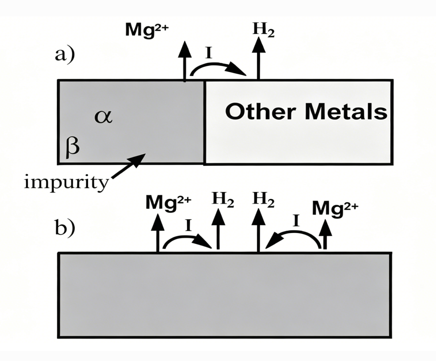 1. Core Corrosion Reactions
Magnesium alloys undergo typical electrochemical corrosion in aqueous environments.
Anodic Dissolution
Magnesium atoms lose electrons and become magnesium ions:
Mg → Mg²⁺ + 2e⁻
Cathodic Hydrogen Evolution
Hydrogen ions capture electrons and generate hydrogen gas:
2H⁺ + 2e⁻ → H₂
Overall Corrosion Reaction
Mg + 2H₂O → Mg(OH)₂ + H₂
The generated magnesium hydroxide film has limited stability and is easily destroyed by corrosive media. Meanwhile, the continuous hydrogen evolution reaction accelerates substrate degradation. Impurity metals such as iron (Fe), nickel (Ni), and copper (Cu) form galvanic couples with magnesium, further increasing the corrosion rate.
2. Fatal Defects of the Natural Oxide Film
Magnesium alloys spontaneously form an oxide film in air, but this film has two critical weaknesses:
Porous and Loose Structure
Its Pilling-Bedworth ratio (P-B ratio) is only 0.81, meaning it cannot form a dense protective barrier like aluminum or stainless steel oxide films.
Nonuniform Thickness and Microcracks
The oxide layer contains numerous microcracks and thickness variations, allowing corrosive media to penetrate rapidly and attack the substrate.
Therefore, natural oxidation alone cannot provide effective protection, making artificial surface treatment essential for building functional protective layers.
3. Core Objectives and General Process Flow of Surface Treatment
The magnesium alloy surface treatment industry generally follows the following process:
Surface Cleaning (Degreasing and Oxide Removal) → Surface Activation → Functional Coating Formation → Sealing/Painting → Performance Testing
According to automotive industry testing, standardized pretreatment can reduce the early coating delamination rate from 4.7% to 0.6%, making process control extremely important.
The overall protection logic can be divided into three categories:
Physical Barrier Protection
Dense coatings isolate the substrate from corrosive media.
Electrochemical Protection
Coating potential design suppresses galvanic corrosion.
Functional Modification
Additional functions such as:
Wear resistance
Electrical insulation
Electromagnetic shielding
Self-healing capabilities
are integrated to meet specific application requirements.
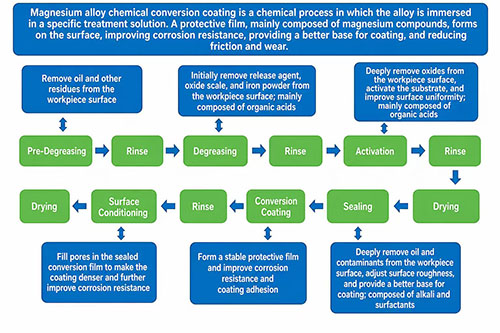
Chemical Conversion Coating (Passivation or Chemical Film Formation)
Chemical conversion coatings are produced by the reaction between magnesium alloys and conversion solutions, forming an inorganic layer composed of oxides or metal salts on the substrate surface.
This coating:
Exhibits strong adhesion to the substrate;
Prevents corrosive media from attacking the base material;
Improves corrosion resistance and coating adhesion.
However, chemical conversion coatings are relatively thin and soft, resulting in limited protective capability.
They are generally used as:
Decorative intermediate layers
Protective primer layers
Typical coating thickness:
0.5–2 μm
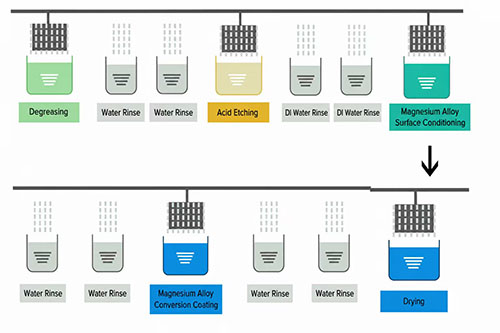
Magnesium Alloy Passivation Process Flow
Degreasing → Water Rinse → Cleaning → Water Rinse → Etching → Water Rinse → Surface Conditioning → Water Rinse → Conversion Coating → Water Rinse → Sealing → Drying
(Note: Water rinsing is generally performed twice in each stage.)
Since conversion coatings are not fully dense, sealing treatment is necessary to achieve better corrosion resistance and a more stable passivation film.
Chemical Conversion and Composite Coating Systems: The Mainstream Solution with the Best Cost Performance
Chemical conversion coating is the earliest and most widely adopted surface treatment technology for magnesium alloys.
It can be divided into:
Single Chemical Conversion Coating
Chemical Conversion + Organic Coating Composite System
This technology is widely used for automotive interior parts and general structural components.
Single Chemical Conversion Coating
Working Principle
Chemical reactions generate non-metallic conversion coatings such as:
Phosphate coatings
Permanganate coatings
Their primary function is to provide a highly adhesive substrate for subsequent painting rather than acting as the final corrosion-resistant layer.
Performance
The coatings are:
Porous and network-like;
Relatively brittle;
Capable of withstanding only 24–48 hours of neutral salt spray testing.
Cost and Processing
The process is:
Mature;
Simple to operate;
Low cost.
Comprehensive processing cost:
USD 0.7–1.4/m² (RMB 5–10/m²)
Applications
Mainly used as pretreatment for:
Electrophoretic coating
Powder coating
Widely applied to:
Cost-sensitive automotive interior components
General-purpose structural parts
Environmentally Friendly Systems
Traditional chromate conversion coatings containing hexavalent chromium are gradually being phased out.
Mainstream chromium-free systems include:
Rare-Earth Cerium Salt System
Coating thickness: 1–3 μm
Neutral salt spray resistance: 100 hours
Phosphate-Permanganate System
Porosity ≤10%
80-hour salt spray resistance without red rust
These systems are highly suitable for environmentally friendly mass production.
Chemical Conversion + Organic Coating Composite System
This is currently the most cost-effective and widely used industrial standard solution.
It creates a dual-protection structure:
Inorganic Conversion Coating + Organic Coating
The conversion layer improves coating adhesion, while electrophoretic paints and powder coatings provide both physical and chemical barriers.
Performance
Neutral salt spray resistance: >500 hours
With special sealing treatment: >1000 hours
Fully compliant with automotive-grade corrosion protection standards.
Benchmark Case
Chongqing University and CATL jointly developed a magnesium alloy battery enclosure protection system using:
1.5 μm rare-earth cerium conversion coating
Waterborne epoxy primer
Performance:
No corrosion after 1000 hours in 5% LiPF₆ electrolyte immersion
Thermal conductivity: 22 W/(m·K)
30% lighter than aluminum solutions
The solution has passed Tesla battery pack certification.
Applications
Humanoid robots
eVTOL and low-altitude drones
New energy vehicle door inner panels
Seat frames
Battery enclosures
This has become the standard anti-corrosion solution for automotive magnesium alloy components.
Functions and Principles of Each Process Step
1. Mild Acid Treatment
A relatively mild acid is used while controlling bath temperature to prevent bath failure.
Benefits:
Removes release agents;
Reduces etchant consumption;
Prevents enlargement of threaded holes.
2. Degreasing
Removes oils and dust generated during machining.
Ultrasonic assistance is generally used to ensure complete removal.
3. Etching
Organic acids remove:
Die-casting release agents
Contaminants
Natural oxides
A black powder forms on the surface, which is generally a complex of organic acids and release agents, such as:
Magnesium citrate salts
Aluminum salts
The more uniform the black powder, the more thoroughly the release agent has been removed.
Activation time depends on contamination severity.
This process must also consider:
Thread dimensions
Product size
Weight control
Chemical consumption
4. Surface Conditioning
Removes residual black powder and adjusts surface activity to promote uniform passivation film formation.
5. Conversion Coating (Passivation)
Forms a uniform calcium phosphate conversion coating.
Functions:
Improved salt spray resistance
Reduced electrical resistance
Enhanced coating adhesion
The conversion chemicals and powder additives should be added proportionally and fully dissolved before production.
6. Sealing
Further improves corrosion resistance.
Concentration, temperature, and processing time directly affect the final appearance and color.
These parameters are positively correlated.
Important Notes
1. Different Sealants
Different sealants require different:
Process conditions
Application scenarios
Technical requirements
Appearance standards
Painted products and cosmetic parts should use different process parameters.
2. Timing of Passivation
Passivation can be performed before or after machining.
If performed after machining, special attention should be paid to:
Threaded holes
Machined holes
Experience shows that threaded surfaces may generate debris after passivation and thread gauge testing.
3. Influence of Release Agents
The amount and composition of die-casting release agents significantly affect:
Cleaning efficiency
Degreasing effectiveness
Chemical conversion coating formation
Corrosion resistance
For example, release agents containing silicon (Si) significantly influence oxide film quality.
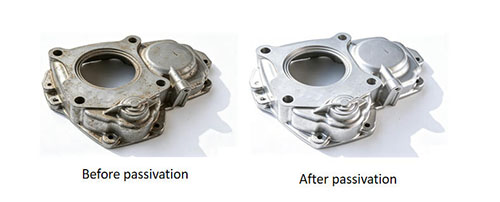
Pretreatment Bath Testing Methods
pH
Total Alkalinity (TAL)
Free Alkalinity (FAL)
Total Acidity (TA)
Free Acidity (FA)
These parameters are measured using standard titration and pH testing methods to ensure stable process control.
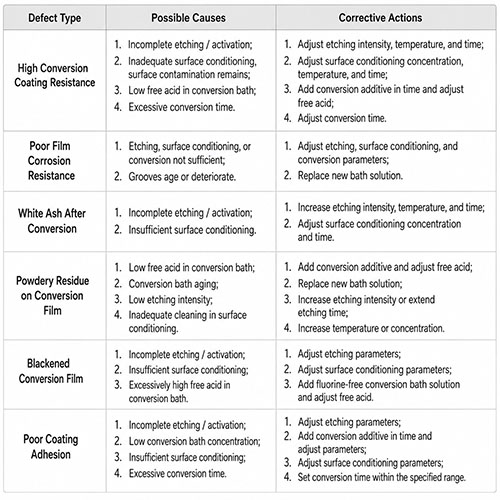
Problems, Causes, and Solutions for Inadequate Passivation of Magnesium Alloys
Full Process Control: Pretreatment, Post-Treatment, and Quality Inspection Systems
Approximately 70% of the success of magnesium alloy surface treatment depends on refined process control, covering pretreatment, post-treatment, and standardized inspection systems.
These systems are the foundation for stable mass production quality.
HuaZheng Precision Manufacturing
HuaZheng has been deeply involved in the custom precision metal manufacturing industry in Shenzhen for over ten years. As a professional manufacturer of magnesium alloy products and a CNC source factory, our products enjoy an excellent reputation both domestically and internationally.
One-Stop Services
Product Design
Prototyping
Low-Volume Production
Mass Production
Product Assembly
Industries Served
Humanoid Robots
Drones
Automotive
New Energy
Aerospace
Telecommunications
Medical
Defense
Artificial Intelligence
Robotics
Industrial Automation
Our Mission
To pursue both the material and spiritual well-being of all partners while contributing to society through innovative craftsmanship and precision manufacturing.
Our Philosophy
Lean Efficiency, Quality First.
Customer Commitment
Fast Response
Quality Assurance
On-Time Delivery
Competitive Pricing
Our Vision
To become a leader in precision intelligent manufacturing and build a century-old happy enterprise.
We have cooperated with Japanese, European, and American customers for more than ten years, who have given us a title we are proud of:
"Quality Inspection-Free Supplier."
Our Core Values
Integrity • Responsibility • Altruism • Gratitude
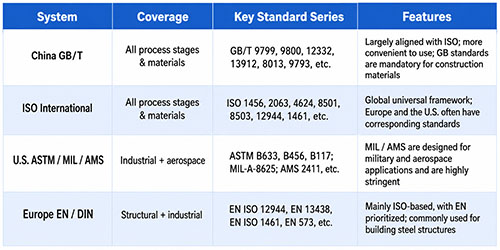
Domestic and International Standards Systems: Authoritative Basis for Process Selection and Acceptance
Magnesium alloy surface treatments should comply with four major standards systems:
GB/T (China)
ISO (International)
ASTM/MIL (USA)
EN (Europe)
These standards provide authoritative guidance for process selection and product acceptance.


