



What Is Copper Plating and electroless copper plating?
Copper plating is usually divided into chemical copper plating and electroplated copper.
Electroplating copper is a technology that uses the principle of electrolytic cells to deposit a metal coating on mechanical products that is well adhered but has different properties and base materials. Electroless plating is a plating method that uses a reducing agent to cause oxidation and reduction in the same solution when there is no current flowing through it (no external power), so that metal ions are reduced and deposited on the autocatalytic surface.
1. Electroless copper plating. Electroless copper plating technology began in 1947. Narcus first reported the chemistry of electroless copper plating solutions. The stability of the electroless copper plating solution in the initial stage is very poor. The solution is easy to decompose automatically, and the plating range cannot be controlled. There are deposits everywhere in contact with the solution. The real commercial electroless copper plating appeared in the 1950s. With the development of printed circuit board (PCB) through-hole metallization, electroless copper plating was the earliest application. The first similar modern electroless copper plating solution was published by Cahill in 1957. The plating solution was an alkaline copper tartrate plating bath and formaldehyde was the reducing agent. Now, after more than 50 years of development and research, a relatively complete solution chemistry knowledge and process technology foundation for electroless plating have been formed, and a preliminary basic theoretical system has been established. Electroless copper plating is to reduce and precipitate copper ions on the surface of catalytically active substances such as palladium through the action of reducing agents such as formaldehyde.
Advantages of Electroless Copper Plating
The advantages of electroless copper plating over electroplating mainly include:
① a wide range of substrates;
② uniform coating thickness;
③ simpler process equipment; and
④ better coating performance.
Electroless plating has a wide range of applications, suitable for metals, metal semiconductors, and various non-metals (ceramics, resins, diamonds, etc.). Electroless copper plating produces uniform layers, unaffected by size or shape, and yields a consistent coating. The coating exhibits excellent adhesion and superior chemical, mechanical, and magnetic properties (such as density and high hardness). Electroless plating is superior to electroplating in some aspects, and some problems can only be solved using electroless plating.
The difference between electroless plating and electroplating is that it does not require an external DC power supply; no external current flows through it, hence it is also called "electroless plating" or "autocatalytic plating." Therefore, electroless plating can be described as "a controllable, autocatalytic chemical reduction process for depositing metals."

Composition of Electroless Copper Plating Solution
The composition of the electroless copper plating solution is crucial to its stability and is a key factor affecting the quality of the plating layer. It also plays a decisive role in the cost and environmental pollution level of electroless copper plating.
1.2.1 Main Salt
Copper sulfate is the most common main salt in electroless copper plating solutions; other copper salts, such as copper chloride, copper oxide, basic copper carbonate, and copper nitrate, can also be used as main salts.
1.2.2 Reducing Agent
Reducing agents in electroless copper plating solutions include formaldehyde (HCHO), hypophosphite (NaH2PO2), amine borane (DMAB), sodium borohydride (NaBH4), hydrazine (N2H4), and sugars.
1.2.3 Complexing Agent
Since electroless copper plating is carried out in an alkaline solution, a complexing agent that can form a stable complex with Cu2+ must be added. This complexing agent stabilizes the plating solution and refines the grain size of the plating layer. Commonly used complexing agents for electroless copper plating include triethanolamine (TEA), potassium sodium tartrate (Tart), disodium ethylenediaminetetraacetate (EDTA·2Na), N’N’N’N’-tetra(2-hydroxypropyl)ethylenediamine (THPED), phenylethylenediaminetetraacetic acid (CDTA), and citric acid.
Currently, most electroless copper plating solutions use mixed complexing agents. For example, replacing some of the expensive EDTA salts with tartrate salts can reduce costs, improve economic efficiency, and enhance the stability of the plating solution.
1.2.4 Additives
The amount of additives used in electroless copper plating is generally tens of milligrams per liter of solution, but they have a significant impact on the deposition rate, solution stability, and coating quality. Based on their function, additives are generally classified into stabilizers, accelerators, and surfactants.
(1) Stabilizers Cu+ is a key factor in instability. Stabilizers are usually compounds that can undergo complexation reactions with Cu+. High stabilizer concentrations can significantly reduce the copper deposition rate or even halt the copper deposition reaction, resulting in only a darker coating.
(2) Accelerators Accelerators have a depolarizing effect, which can speed up the plating process. Examples include monoamines, ammonium salts, tungstates, chlorides, benzodiazepines, cytosine, and guanidine. For hypophosphite electroless copper plating systems, NiSO4 and NiCl2 can be used as accelerators.
(3) Surfactants Since the electroless copper plating reaction involves the generation of hydrogen gas, hydrogen bubbles are adsorbed in the precipitated coating, leading to hydrogen embrittlement. Adding surfactants to the plating solution helps reduce the surface tension of the solution, making it easier for the generated hydrogen gas to detach from the surface of the precipitated copper layer, thus reducing hydrogen embrittlement. Nonionic surfactants, especially low-foaming PEG, are commonly used in electroless copper plating solutions.
1.2.5 pH Adjusters
In electroless copper plating, NaOH, KOH, LiOH, and H2SO4 are commonly used as pH adjusters. In the oxidation reaction of the reducing agent, the disproportionation reaction ability of caustic alkali on formaldehyde is KOH < NaOH < LiOH, and the mechanical properties of the resulting coating are KOH < NaOH < LiOH. In industrial applications, NaOH is commonly used to provide the OH- ions required for electroless copper plating, while sulfuric acid is used to lower the pH value of the plating solution. pH adjusters are typically used to adjust the pH value of the plating solution to a suitable process range.
What Is copper electroplating?
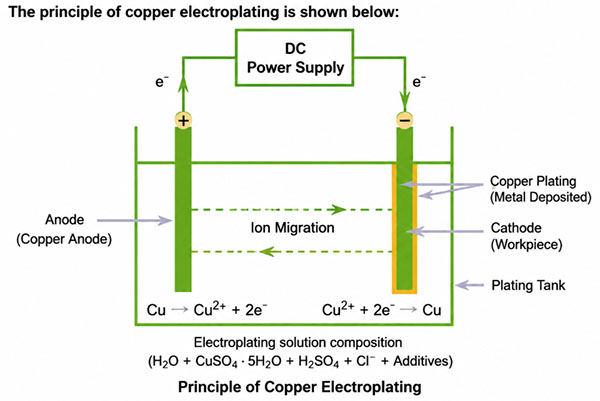
Copper electroplating has been used in the PCB manufacturing industry for many years. The copper plating solution for printed circuit boards is acidic, characterized by high acidity and low copper content, resulting in excellent dispersion and deep plating capabilities. The plated copper layer has a glossy finish. In the PCB process, the copper plating layer serves two purposes: one is full-board copper plating, protecting the newly deposited thin layer of chemical copper from oxidation and subsequent acid etching. Electroplating thickens this layer to a certain thickness, typically 5-8 μm, also known as primary copper plating. The other is patterned copper plating, thickening the copper in holes and circuits to a certain thickness or serving as a nickel underlayer, typically 20-25 μm thick, also known as secondary copper plating.
Electroplated layers are more uniform than hot-dip galvanized layers and are generally thinner, ranging from a few micrometers to tens of micrometers. This requires electrolysis equipment, making the operation cumbersome and costly.
2.1 Copper Electroplating Process
Acidic Cleaning (5±1 min) - Overflow Rinse (90±30 sec) - Overflow Rinse (90±30 sec) - Micro-etching (10±2 sec) - Overflow Rinse (90±30 sec) - Overflow Rinse (90±30 sec) - Acid Immersion (50±10 sec) - Copper Plating - Water Rinse (90±30 sec) - Drying
2.1.1 Acidic Cleaning
① Purpose and Function: To remove oxides, ink residue, and residual adhesive from the copper surface of the circuit, ensuring the adhesion between the primary copper and the copper or nickel plating of the pattern.
② Pattern ink is not alkali-resistant and will damage the pattern circuit; therefore, only acidic degreasing agents can be used before pattern electroplating.
③ During production, only the concentration and time of the degreasing agent need to be controlled. The degreasing agent concentration should be around 7%, and the time should be guaranteed to be around 5 minutes. A slightly longer time will not have adverse effects. The tank solution should be replaced at a rate of 15 square meters per solution, and replenished at 0.5-0.8 L per 100 square meters.
2.1.2 Micro-etching
① Purpose and function: To clean and roughen the copper surface of the circuit, ensuring the adhesion between the patterned copper plating and the primary copper.
② Sodium persulfate is often used as the micro-etching agent. It provides a stable and uniform roughening rate and good water washability. The sodium persulfate concentration is generally controlled at around 7.5 g/L, and the time is controlled at around 10 seconds. The chemical addition is 1-2 kg per 100 square meters; the copper content should be controlled below 20 g/L; other maintenance and tank replacement are the same as for copper plating micro-etching.
2.1.3 Acid Immersion
① Purpose and Function: To remove oxides from the plate surface and activate it. The concentration is generally 5%, sometimes maintained around 10%, mainly to prevent water from introducing and causing instability in the sulfuric acid content of the plating bath;
② The acid immersion time should not be too long to prevent passivation of the plate surface; after a period of use, if the acid solution becomes cloudy or the copper content is too high, it should be replaced promptly to prevent contamination of the electroplating tank and the plate surface;
③ C.P. grade sulfuric acid should be used here;

2.2 Essential Components for Copper Plating Production
1. Copper Sulfate (CuSO4)
This is the main salt in the plating solution. It ionizes in aqueous solution to release copper ions, which are the primary source of the copper plating layer.
2. Sulfuric Acid
In the plating solution, it ionizes to release a large amount of H+ ions. This significantly reduces the resistivity of the plating solution, increases its conductivity, and prevents copper sulfate from hydrolyzing into cuprous oxide. Increasing the sulfuric acid content improves the dispersion ability of the plating solution and enhances the uniformity of the plating layer. However, too high a content will increase the brittleness of the plating layer, while too low a content will result in a rough plating layer and anode passivation.
3. Chloride Ions
They work together with brighteners to make the plating layer bright. Cl- also allows for normal anode dissolution, but if added in excess, it will cause anode passivation and the appearance of a white precipitate.
4. Anode (Phosphorus Copper Balls)
The anode contains phosphorus, which forms a black protective film on the anode surface. This film controls the copper dissolution rate, ensuring similar anode and cathode current efficiencies, preventing Cu+ formation, and minimizing anode sludge production. Regular anode cleaning ensures an appropriate anode film thickness and controls anode quality. Increased anode sludge leads to a rougher plating layer.
5. Anode Bag
To collect fine copper shavings generated during anode dissolution and ensure plating solution cleanliness, an anode bag made of polypropylene or polypropylene cloth should be placed over the anode. New bags should be deslurried before use. The anode bag should be frequently filtered and replaced. After rinsing with clean water, the used filter bag should first be coarsened with an H2SO4-H2O2 solution to dissolve the adsorbed copper powder, followed by a water rinse-alkali (5%) immersion-water rinse-acid (5%) immersion treatment. 6. Titanium Basket
Spherical phosphor bronze balls are best placed in titanium baskets. Firstly, they have the largest surface area for the same weight. Secondly, adding phosphor bronze balls can maintain the stability of the anode area and prevent the phenomenon of the top being larger than the bottom during use.

2.3 Points to Note in Copper Plating
1. Anode and Cathode
The anode should be 7-8 cm shorter than the cathode to prevent uneven electric field distribution and edge scorching. The distance between the anode and cathode should generally be at least 15-20 cm, with the anode being 10 cm narrower than the cathode. The ratio of anode area to cathode area should be 1.5-2:1.
2. Current Density
Too high a current density will reduce plating uniformity and result in a rough appearance due to the current edge effect; too low a current density will result in a dull plating layer and low production efficiency. During electroplating, two potentiometers should be used to adjust and control the current on both sides of the board to solve the problem of uneven current distribution caused by different patterns on the two sides. Current Amperes = Length (dm) * Width (dm) * 2 * Current Density * Number of Boards
3. Air Agitation
Air agitation can reduce copper ion concentration polarization, increase the allowable cathode current density, thereby increasing cathode polarization and facilitating the formation of a fine-grained plating layer. Air agitation can also oxidize Cu+ in the solution to Cu2+, eliminating Cu+ interference. 4. Cathode Movement (Swing) + Air Agitation + Continuous Filtration
Not only does it provide strong agitation, but it also continuously purifies the plating solution, eliminating pinholes, bubbles, nodules, etc., resulting in better plating quality.
Design Considerations for the Hanger and its Impact on Electroplating Quality
Design Considerations:
(1) Excellent electrical conductivity
(2) Easy for employees to operate, ensuring both uniform copper plating and production output. Generally, the hanger is designed with 6 clamping points; small layouts hang 2 PNL per rack, and large layouts hang 1 PNL per rack.
(3) Suitable for clamping flexible boards; the width can be adjusted according to the board size.
(4) Not easily damaged and easy to maintain.
(5) The lower the resistance of the hanger, the better.
Currently, white hangers are used for flexible boards. These hangers are made of stainless steel, have excellent conductivity, and are produced using Canadian technology, placing them at the forefront of the domestic industry.
Impact of Poor Hanger Design on Electroplating Quality
(1) Poor conductivity of the hanger will cause uneven electroplating.
(2) Excessive resistance of the hanger will increase the tank voltage, reduce the efficiency of anodic electroplating, and affect the quality of copper plating.
Operational Requirements
(1) Handle the upper and lower plates gently and carefully to avoid scratching.
(2) Wear PVC or latex gloves when loading the plates. The gloves should be for specific purposes and should not be used for other maintenance tasks. Keep the gloves clean.
(3) Ensure that the screws at the hanging points and clamping points of the plates are tightened.
(4) Ensure that the plates on the rack are in a vertical position.
(5) Ensure good conductivity.
(6) The upper, lower, and baking plates should be held diagonally and horizontally.

What's the difference between electroless copper plating and electroplated copper?
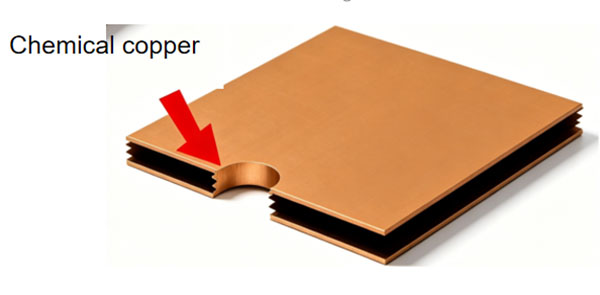 Electroless copper plating (also known as immersion copper plating) is an extremely thin layer of conductive copper deposited on a non-conductive substrate through a self-catalytic chemical reaction. Its core function is to achieve conductivity on the pore walls, providing a foundation for subsequent electroplating.
It works by adsorbing catalytically active substances (such as palladium) onto the pore wall surface. Then, under alkaline conditions without an applied current, a reducing agent (such as formaldehyde) reduces copper ions in the solution to metallic copper, which is then uniformly deposited on the pore walls, forming a continuous, very thin (typically 0.3–1.0 μm) electroless copper layer.
The chemical reaction is as follows:
Cu²⁺ + 2HCHO + 4OH⁻ → Cu + 2HCOO⁻ + 2H₂O + H₂↑
Copper electroplating, as the name suggests, involves electroplating a layer of copper using the principle of electrolysis. Electrodes are inserted into an electroplating tank, and an external current is applied to reduce copper ions to metallic copper, which is then deposited onto the circuitry and hole walls. As the current flows, metal is deposited, thickening the surface copper to meet current carrying capacity and mechanical strength requirements. Currently, copper plating solutions used on circuit boards primarily consist of copper sulfate and sulfuric acid, with small amounts of additives and hydrochloric acid.
In the copper electroplating process, phosphorus copper balls (mainly composed of electrolytic copper) or insoluble anodes are used as the anode, the workpiece to be plated is the cathode, and copper sulfate solution is the electrolyte. The electrochemical reactions are as follows:
Cathode reaction (reduction reaction):
Cu²⁺ + 2e⁻ → Cu
Anode reaction (oxidation reaction):
Cu → Cu²⁺ + 2e⁻
Chemical copper plating is a process of creating something from nothing. It "seeds" a thin copper film onto the walls of insulating vias, making the vias conductive and solving the problem of the insulating materials' inability to conduct electricity. It is the cornerstone of multilayer board interconnects.
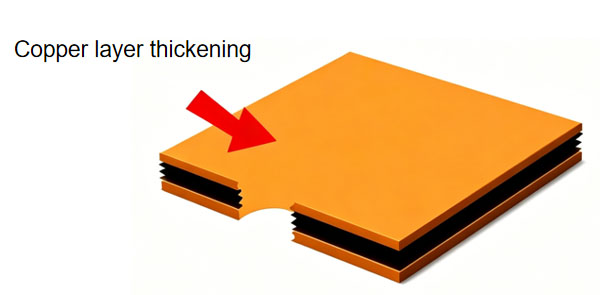
Electroplating copper, on the other hand, is a process of thickening from thin to thick, ensuring that the circuitry and vias have sufficient electrical properties and durability.
In actual production, the two are often used in combination: first, copper plating forms a conductive layer, and then the target area is gradually thickened through panel plating and pattern plating.
In summary: first, copper plating conducts electricity, then electroplating thickens the layer; copper plating is the foundation, and electroplating is the reinforcement.
Comparison table of differences between the two
Feature | Electroless Copper Plating | Electroplated Copper |
Purpose | Establish an initial conductive layer (on non-conductive surfaces) | Increase conductive layer thickness (on conductive substrates) |
Principle | Chemical reduction reaction (autocatalytic, no external current required) | Electrochemical deposition (requires external current) |
Driving Force | Chemical reducing agents | Electricity |
Thickness | Very thin (0.3–1.0 μm) | Thick (15–25+ μm) |
Conductive Base | Required (provides conductive pathway for plating) | Depends on conductive base provided by electroless copper |
Key Function | First step of metallization to achieve initial conductivity | Enhances conductivity, mechanical strength, and corrosion resistance |
Process Order | Performed first | Performed after electroless copper plating |
Cost | Relatively high (expensive catalysts and maintenance) | Relatively lower (electricity consumption dominates) |
Deposition Rate | Slow | Fast |
Common Defects in Copper Plating: Causes and Countermeasures
Defect | Possible Causes | Countermeasures |
Coating Roughness | 1、Plating additives out of balance 2、Plating solution contamination 3、Chloride (Cl⁻) too low 4、Excess current density 5、Excess organic impurities | 1、Adjust brightener concentration using Hull cell test 2、Replace filter element 3、Analyze and adjust chloride content 4、Reduce current density 5、Activated carbon treatment |
Burnt Coating | 1、Low Cu2t concentration 2、Low sulfuric acid concentration 3、Excess anode current density 4、Low bath temperature 5、Brightener imbalance 6、Insufficient agitation | 1、Replenish copper sulfate to specification 2、Adjust acid concentration 3、Reduce current density 4、Increase electrolyte temperature 5、Adjust via Hull cell test 6、Increase stirring/aeration |
Pitting / Holes | 1、Poor coverage in shadow areas 2、Dry film cracks 3、Misaligned drill holes 4、Poor drilling quality 5、Laminate defects 6、Gas bubbles trapped in holes | 1、Optimize plating parameters 2、Improve film quality / process 3、Improve alignment accuracy 4、Improve drilling process 5、Inspect substrate quality 6、Improve aeration and circulation |
Common problems and troubleshooting methods of acidic copper plating solutions
Defect Phenomenon | Possible Causes | Corrective Actions |
Poor adhesion of the coating | Inadequate pre-treatment Plating thickness too thin Poor conductivity Poor conductivity Metal content in plating solution too low | Strengthen pre-treatment Increase plating thickness Check and ensure proper electrical contact Analyze and adjust metal content to the specified range |
Insufficient brightness of the coating | Brightener insufficient Chloride (Cl⁻) insufficient Low plating solution temperature Sulfuric acid concentration too low Plating solution contaminated by impurities Anode area insufficient | Use Hull cell test and add appropriate brightener Optimize chloride ion content and oxidative treatment of organic matter Raise temperature Analyze and adjust Filtration treatment Increase anode area |
Insufficient brightness after DK treatment (DK dullness) | Brightener insufficient Plating solution temperature too high DK time too long One-stage copper in the plating bath too high Plating solution contaminated by impurities | Add appropriate brightener Lower temperature Shorten DK time Check anode ratio and replenishment of copper sulfate Filtration treatment |
Pinholes in the coating | Brightener insufficient One-stage copper in the plating bath too high Chloride (Cl⁻) insufficient Stress in the plating solution | Add appropriate brightener Check anode ratio and replenish copper sulfate Add calculated amount of hydrochloric acid Stress relief treatment |
Striated coating (lines or streaks) | Chloride (Cl⁻) deviation Excessive filtration Low plating solution temperature | Add calculated amount of hydrochloric acid Adjust filtration rate or method Raise temperature |
Coating edge over-etching or burning (edge erosion) | Low plating solution temperature Sulfuric acid concentration too low DK time too long | Increase temperature Replenish sulfuric acid Shorten DK time |
Burnt deposit | Additive overdose or deficiency Insufficient S3108 additive | Make Hull cell test adjustment Replenish S3108 additive |
Brittle deposit | Additive imbalance | Add appropriate additive |
Stress cracking | Chloride (Cl⁻) deviation Sulfuric acid concentration too high Plating solution contaminated by impurities | Add calculated amount of hydrochloric acid Adjust Filtration treatment |
Coating peeling | Iron impurities excessive; plating time too long will cause iron deposition | Partially replace or fully replace the plating solution |


